The Paradox
When priests retire, they don't stop being priests. This paradox can be difficult to navigate both inwardly and outwardly. Some clergy have a strong desire to continue exercising the role, whilst others desire change. Many want to blend the two, stepping back, but not away.
The materials below provide a framework to work through these challenges, to start developing a plan that fits your own unique life and circumstances
Author: Claudia Smith // Counsellor & Church Lead // Thrive Worldwide
A significant transition
Retirement is a significant transition for anyone in their life, but for church ministers, it holds additional significance. From that initial call to ministry, to the study and formation involved in qualifying a minister, to how you see yourself, as well as how others see you: it is far more than just a 9–5 job. And so retirement is not simply a case of clearing your desk and walking out of the door (though there may be a temptation to do just that). It is a transition with many layers.
The challenges
At times of change we often focus on the practical things we have to do — clearing the office, organising pensions, packing up belongings and moving house. These in themselves are a lot to manage mentally and practically – but retirement from ministry is so much more than that.
It often means saying goodbye to people you have known, served, and prayed for over many years — people bound up in memories of births, baptisms, weddings, funerals, and everything in between. It involves saying goodbye to that which you love, but also that which has involved blood, sweat and tears.
And so it can be a chaotic time — not just in the number of boxes that need sorting and packing, but emotionally too. You may move from feeling involved, committed, and settled, with a sense of belonging and purpose, to potentially feeling unsettled as ties loosen, relationships gradually disengage, and roles are relinquished as the letting go of ministry, or moving to ministry in retirement, unfolds. This can bring feelings of sadness, anxiety, and fear, as well as anticipation of what lies ahead. You may even resent the changes that are occurring.
In this in-between phase, with its lack of structure and usual routines, it is normal to feel unsettled, disoriented and to experience a rollercoaster of emotions, from anxiety to excitement and peace to panic. You may experience a sense of relief or disappointment depending on your circumstances, and feelings of loss are common in the letting go of elements of ministry you have invested yourself in.
Taking time to reflect
In the midst of this, it is so important to pause and reflect on your ministry journey. Just as you plan and prepare for the physical move, so too you should reflect on your thoughts and feelings about retiring from ministry as a way to mentally and emotionally prepare for the transition.
It can be tempting to simply "keep calm and move on", since reflecting may mean acknowledging and feeling the pain of loss, or a sense of disappointment about things you wished had been different. Yet to skip the reflection is also to miss out on celebrating the joys — all the wonderful times, the things that went really well, the memories of people and experiences that have touched your heart and soul.
Taking time to look back honestly on your ministry can be invaluable in ending well and establishing a firm foundation from which to move into retirement.
The RAFT Model
The RAFT model, created by David Pollock and Ruth Van Reken, provides a helpful framework for reflecting on the highs and lows, the good, the bad, and the ugly of ministry — as well as beginning to look ahead to what comes next. It is a four-step model standing for Reconciliation, Affirmation, Farewell, and Think Destination, designed to help people navigate transitions with emotional clarity and resilience. Each step invites a different kind of intentional reflection.
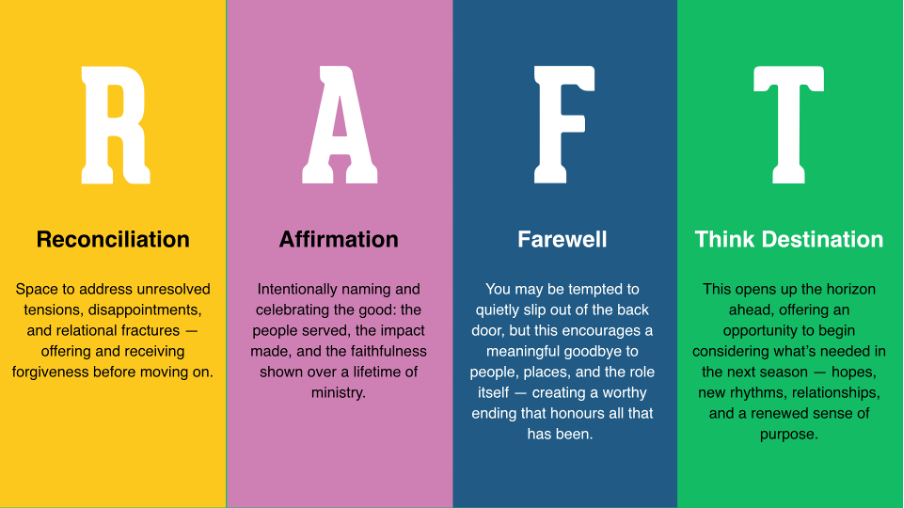
A reflective journal based on the RAFT model is available to help you reflect on and prepare for retirement. To access it, please click the orange 'download resource' link at the top right of this resource
Each transition is different
It is worth saying that not every ministry journey ends in the same way — some will look back with warmth and gratitude, while others may carry wounds, weariness, or a sense of unfinished business. If retirement arrives as a welcome relief after seasons of real struggle, the invitation to reflect may feel complicated or even painful. That is understood, and that too deserves its own gentle space.
Preparing for retirement need not be just about clearing out clutter or packing boxes — it need not be merely a task to get through, a to-do list to tick off. Taking time to reflect on your ministry journey can be a gift to yourself: a beautiful and meaningful ending that opens the door to a new beginning in retirement.
"What we call the beginning is often the end. And to make an end is to make a beginning. The end is where we start from." — T.S. Eliot