Author Dr Matt Edwards // Chief Clinical Officer // Thrive Worldwide
There's a particular kind of exhaustion that many clergy carry into retirement — not just a physical tiredness, but the cumulative weight of years of giving. Decades of being available at all times of day and night, being needed, being present for others in their darkest and brightest moments. And then, often quite suddenly, a different phase of life begins.
For most people, retirement means leaving a job. For clergy, it can feel like leaving who you are. That's why thinking about health in retirement — real, whole-person health — matters so much for those who have given themselves so fully to others. Not just managing conditions or ticking health checks and screening boxes (though those things genuinely matter), but rediscovering what it means for you to thrive.
The body keeps the score
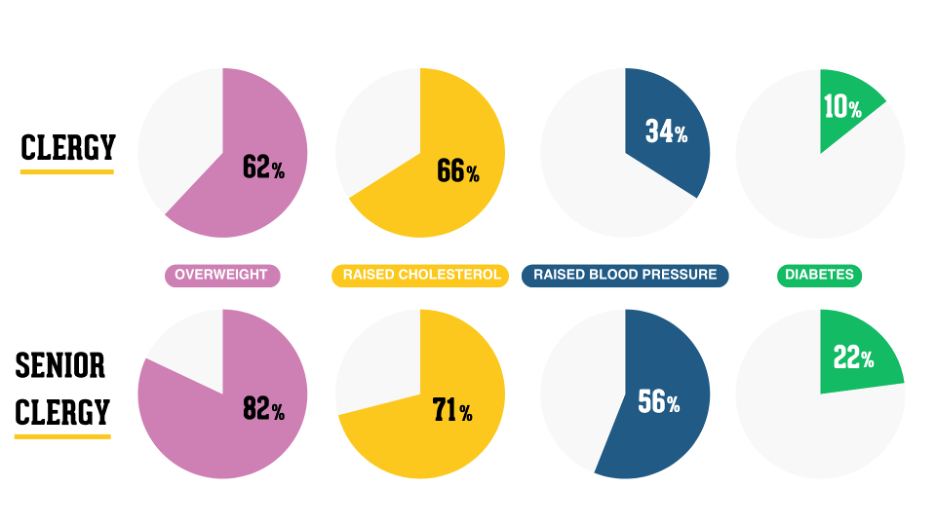
The statistics are quite sobering. Research from our health reviews conducted among clergy found that 62% were overweight or obese, 66% had raised cholesterol, 36% had raised blood pressure and about 10% had Diabetes. And more recently among senior clergy this rose to 82% being overweight or obese, 71% had raised cholesterol, 56% had raised blood pressure and about 22% had Diabetes — these figures are higher than the general population and are all significant risk factors for heart attack and stroke and which are often undetected and unaddressed. Years of parish life, irregular meals, ‘more tea and cake vicar?’, sedentary habits, deferred appointments and a tendency to put everyone else first all take their toll.
Retirement offers a genuine opportunity to change this. Not out of worry or self promotion, but out of a proper valuing of the body as something worth caring for. Getting your cholesterol, blood sugars and blood pressure checked, adjusting diet, finding exercise that is actually enjoyable rather than punishing — these aren't selfish acts. They are acts of stewardship of your body.
I have worked extensively with clergy health for almost twenty years, and I like to remind those whose lives are given to help others simply that: "Self care is not selfish, it is essential to be your best and give your best at whatever stage of ministry and life you are at.”
Know Your Numbers
A key part of managing health conditions or keeping on top of your physical health is knowing the important numbers: where you stand and what needs working on. Some key aspects to be aware of and get checked yearly include:
- Blood pressure: this should generally be below 140 / 90 in the clinic and 135 / 85 when checked at home.
- Cholesterol: this should generally be below 5 for the total cholesterol, with an HDL (good cholesterol) above 1 and an LDL (bad cholesterol) below 3.5.
- The Q-risk3 score: this is a calculation tool used to estimate your likelihood of developing cardiovascular disease, and it should be below 10%
- Body Mass Index (BMI): ideally this should be 25 or below to be a healthy weight, for some ethnicities (e.g. South Asian, Middle Eastern, Chinese and Black populations) this is 23 or below.
- Blood sugars: in a diabetes blood test, a fasting blood level below 6.0 is normal, while between 6.1 and 6.9 is considered pre-diabetes and 7 or above, diabetes.
Screening
There are a number of screening tests available in the UK. These are really beneficial as they check for diseases in seemingly healthy people before any symptoms appear. Catching conditions early makes treatments far more effective, can prevent complications, and ultimately saves lives. Now that you may generally have more time, and if you haven’t already, then take part in any screening available:
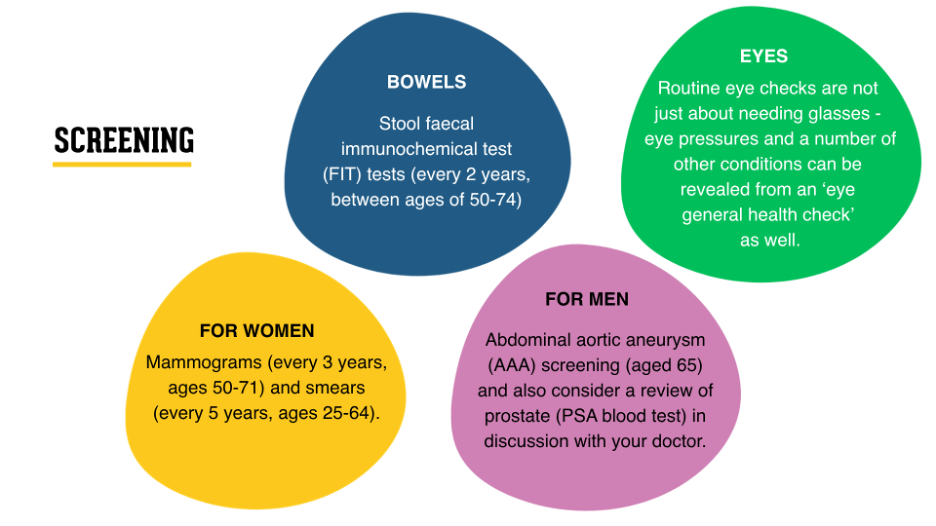
- For Women: Mammograms (every 3 years, ages 50-71) and smears (every 5 years, ages 25-64).
- For Men: Abdominal aortic aneurysm (AAA) screening (aged 65) and also consider a review of prostate (PSA blood test) in discussion with your doctor.
- Please note if you are transgender or non-binary, we encourage you to discuss which routine screenings apply to your specific circumstances with your GP
- Bowels: Stool faecal immunochemical test (FIT) tests (every 2 years, between ages of 50-74)
- Eyes: Routine eye checks are not just about needing glasses - eye pressures and a number of other conditions can be revealed from an ‘eye general health check’ as well.
Vaccinations
Vaccines for over 65s, or those in higher risk health groups, provide important health benefits, including reduced risk of serious illnesses (like pneumonia, meningitis, and severe flu), fewer hospitalisations, and overall disease prevention. Know what vaccinations are available and make sure you are getting them. Further information is available on the downloadable health checklists that accompany this resource
Other Health Conditions
As you approach retirement you may well have some of the conditions mentioned already and / or other health conditions that you have been managing during your ministry. Retirement is a time to really focus on getting on top of appointments and conditions that you may have neglected up to now. There is still time!
The Harder Transition
Physical health, though, is only part of the picture. Often the deeper challenge of clergy retirement is the internal one. Identity, for many ministers, has been tightly woven into the role. The collar, the title, the being known in a community — these are not just superficial things. Losing them, even in a planned and positive retirement, can bring a form of grief that catches people off guard. It can affect your mood. The diary, once relentlessly full, can feel uncomfortably empty.
It's worth saying clearly: this is normal. It doesn't mean something has gone wrong, or that faith has faltered. It means you are human, and that significant change is significant. So what helps?
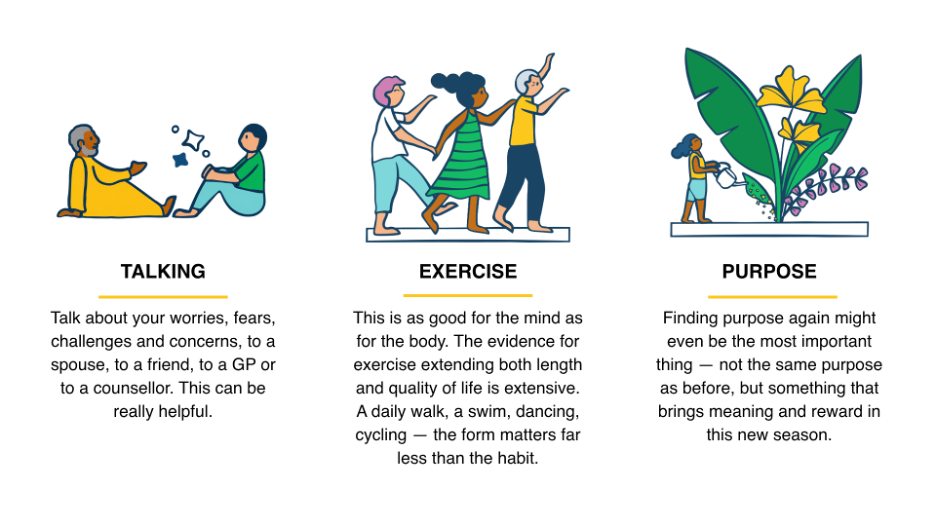
- Talking. Talk about your worries, fears, challenges and concerns, to a spouse, to a friend, to a GP or to a counsellor. This can be really helpful.
- Exercise. This is as good for the mind as for the body. The evidence for exercise extending both length and quality of life is extensive. A daily walk, a swim, dancing, cycling — the form matters far less than the habit.
- Purpose. Finding purpose again might even be the most important thing — not the same purpose as before, but something that brings meaning and reward in this new season.
Purpose isn't a luxury — it's a health intervention. Whether that's a passion project, volunteering, mentoring, learning something new, or deepening family relationships, the question worth sitting with is: what do I enjoy doing, and what gives me a sense of fulfillment?
Wholeness as a framework
At Thrive Worldwide, we work with clergy and mission workers worldwide, and we use a framework of thriving that goes beyond physical metrics. One of the principles in this framework is that thriving is holistic — it involves the whole person in body, mind and spirit. It also involves belonging (forming meaningful connections with family, friends and community), meaning (having purpose that is integral to flourishing), and fullness (not merely surviving, but living life to the full). These aren't abstract ideals. They are practical principles worth reflecting on regularly.
A practical invitation
None of this requires grand gestures. Wholeness in retirement is built in small, consistent choices and developing new patterns and routines: the walk taken, the appointment made, the conversation had, the new community joined, the quiet hour protected.
If you haven't had a health review recently, that's a sensible place to start. Not because you expect to find something wrong, but because knowing your numbers — blood pressure, cholesterol, blood glucose — gives you agency. You can't change what you don’t know about and haven't checked or measured.
Then beyond the numbers, take stock of the whole picture. Are you active and moving? Are you connected? Do you have something to look forward to? Is your spiritual life being nurtured?
You've spent years helping others answer those questions. You're allowed to ask them of yourself now.
We have prepared a health checklist to help you follow some of the recommendations in this post: please click on the orange 'download resource' link at the top of this page to download them. If you've not yet watched Matt's 'Looking After Your Health In Retirement' video then you can do so at the top of this page.
Thrive Worldwide offers health reviews and wellbeing support for clergy and mission workers. To find out more, visit www.thrive-worldwide.org or email info@thrive-worldwide.org